Publications
Click on the images to learn more about each individual report. Also check out our exciting array of interactive tools and data consulting services!
RECENT REPORTS
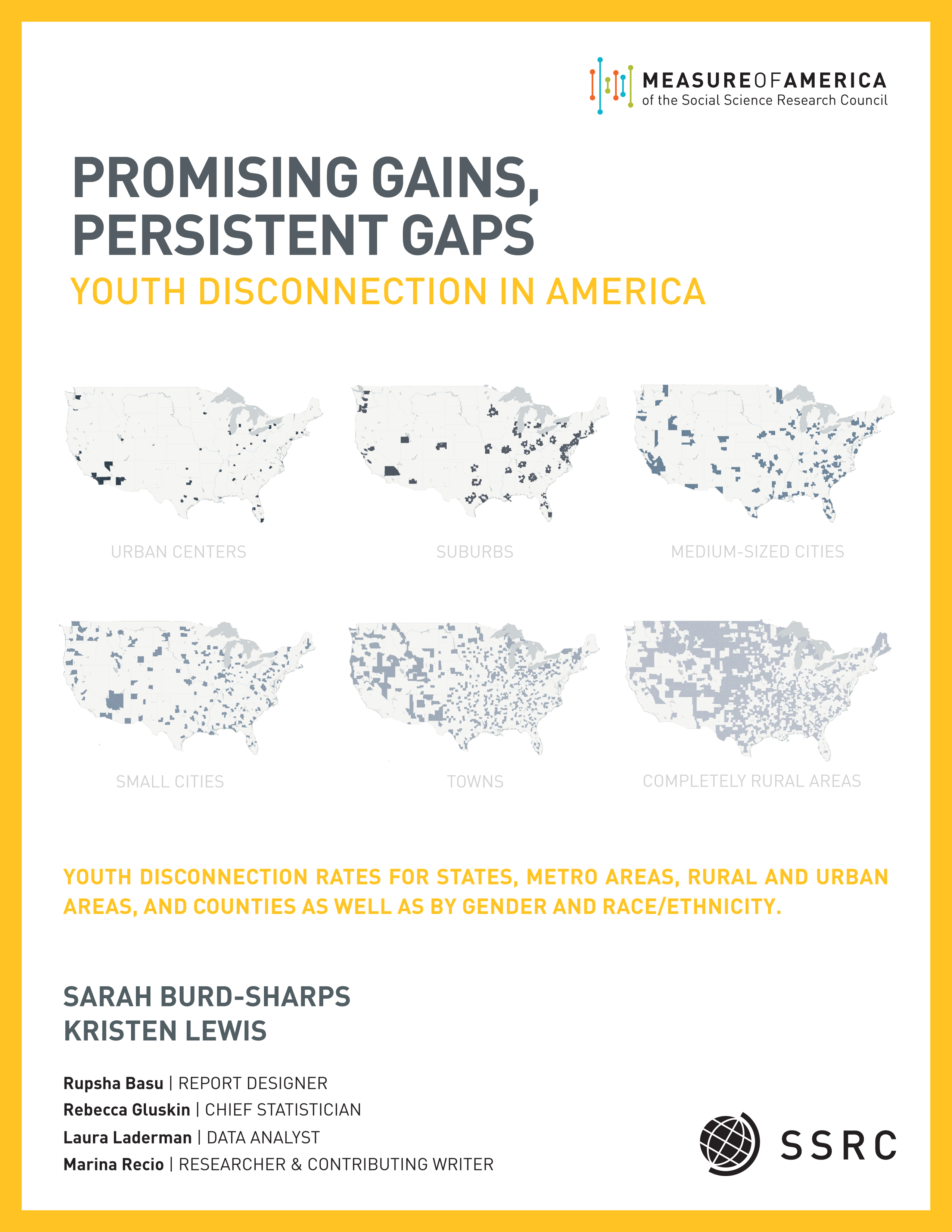
Promising Gains, Persistent Gaps: Youth Disconnection in America finds that the youth disconnection rate has fallen steadily since its high of 14.7 percent in 2010 and is now lower than it was before the start of the Great Recession. While the decline is great news, there are still nearly 4.9 million young people in the United States who are detached from both school and the workforce. In addition, the report offers MOA’s first-ever exploration of how youth disconnection differs in rural, suburban, and urban communities. Check out the accompanying interactive site to explore the latest youth disconnection data.
Goals for the Common Good 2016:
This report is a companion piece to the recently re-launched online Common Good Forecaster,™ a joint product of United Way and the American Human Development Project. It takes a closer look at the ten indicators featured on the Forecaster and makes the case for why education matters to each of these critical areas.
Retail and Opportunity
Opportunity Nation commissioned Measure of America to explore which factors, beyond wages, influence economic opportunity and long-term economic security for retail workers and the communities in which they live. The resulting paper, “Retail and Opportunity”, was an input to an Opportunity Nation issue brief called “RETAIL’S OPPORTUNITY: Exploring the Industry’s Impact on People and Places”.
NATIONAL REPORTS
 Geographies of Opportunity:
This is Measure of America’s fourth national-level report. Geographies of Opportunity: Ranking Well-Being by Congressional District is an in-depth look at how residents of America’s 436 congressional districts are faring in three fundamental areas of life: health, access to knowledge, and living standards.
 The Measure of America 2013-2014:
This third volume in the Measure of America series contains American Human Development Index ranking for the 50 U.S. states, the 25 largest metropolitan areas, and racial and ethnic groups within those states and metro areas. It also looks at changes in well-being in states since 2000 and in metro areas before and after the Great Recession.
 The Measure of America 2010-2011:
An easy-to-understand guide to where different groups stand today, and why. The book contains American Human Development Index rankings for all 50 states, 435 congressional districts, major metropolitan areas, racial and ethnic groups, as well as men and women. It concludes with a set of recommendations for priority actions required to close the stark gaps that separate groups. Order from NYUP or Kindle.

The Measure of America 2008-2009:
The first report marks the first-ever human development report for a developed nation, as well as the first life expectancy calculations for major racial and ethnic groups, states, and congressional districts in the United States. The report introduces the American Human Development Index, and outlines challenges as well as recommendations to improve human development scores.
STATE AND LOCAL REPORTS
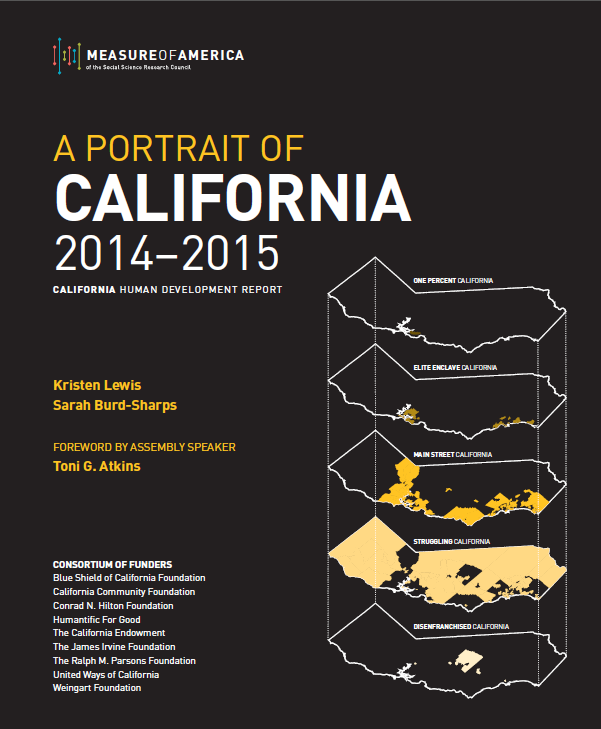
A Portrait of California 2014-2015:
Instead of relying only on economic analysis, Measure of America’s A Portrait of California uses the human development approach to tell us how people are doing. Three dimensions—a long and healthy life, access to knowledge, and a decent standard of living—are examined in detail and presented along a simple ten-point scale: the American Human Development (HD) Index.
 A Portrait of Sonoma County 2014:
Commissioned by the County of Sonoma Department of Health Services, the report draws attention to disparities within the Sonoma community and highlights methods to address the often interlocking disadvantages faced by families who are falling behind.
 A Portrait of Marin 2012:
While Marin as a whole scores extremely high on the American Human Development Index, a closer examination at the Census Tract level shows large gaps between differing groups. This report outlines particular human development challenges in Marin and concludes with a set recommendations to close these gaps.
 A Portrait of California 2011:
This timely report goes beyond the state’s fiscal and budgetary woes to examine the well-being of its people using the American Human Development Index to rank all 233 Census neighborhoods, and introduces the ‘Five Californias’ to highlight the varied opportunities open to differing groups.
 A Portrait of Louisiana 2009:
Louisiana ranks 49th among U.S. states and Washington, D.C. on the American Human Development Index. This study examines the wide disparities within the state by parish, race, and gender in Louisiana, and calls for action to address the acute human vulnerability that persists today, four years after Hurricane Katrina.
 A Portrait of Mississippi 2009:
Mississippi ranks last among U.S. states on the American Human Development Index. But some groups in the state enjoy well-being levels similar to those in top-ranked Connecticut, while others experience levels of human development of the average American nearly a half century ago.
YOUTH DISCONNECTION
 Zeroing In on Place and Race: Youth Disconnection in America’s Cities
In June 2015, Measure of America released its third study of disconnected youth. Zeroing In on Place and Race is an in-depth look at how disconnected youth are faring in 98 of America’s 100 most populous cities, with data included on disconnected youth by state, congressional district, county, gender, and by race and ethnicity.
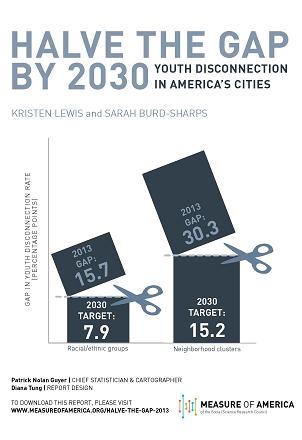
Halve the Gap by 2030: Youth Disconnection in America’s Cities
In September 2012, Measure of America published its initial research on the epidemic of youth disconnection called One in Seven. This report updates 2012’s findings with the latest numbers and, to better map the landscape of youth disconnection, also presents the data by neighborhood cluster for each of the twenty-five most populous US metro areas.
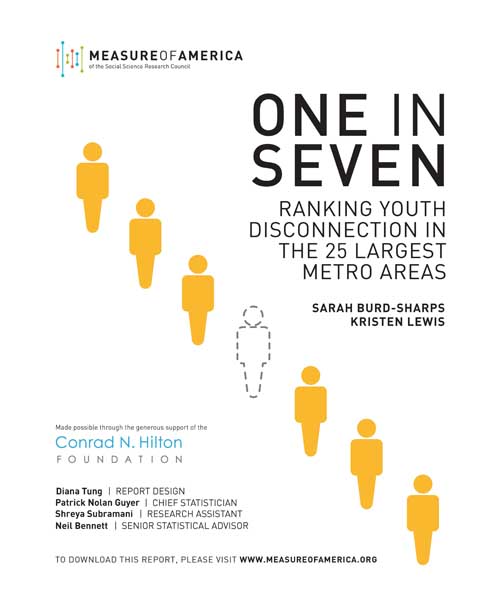
One in Seven: Ranking Youth Disconnection in the 25 Largest Metro Areas:
An astonishing one in every seven Americans ages 16 to 24 is neither working nor in school—5.8 million young people in all. As their peers lay the foundation for a productive, fulfilling adulthood, these disconnected youth find themselves adrift at society’s margins, unmoored from the structures that confer knowledge, skills, identity, and purpose.
THEMATIC BRIEFS
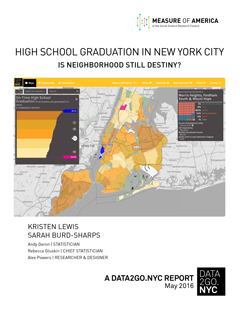 High School Graduation in New York City: Is Neighborhood Still Destiny? is an in-depth look at disparities in on-time high school graduation rates by New York City neighborhood. It contributes to the ongoing discussion around high school quality, outcomes, and choice in the City by presenting the on-time graduation rates for high school students not by the schools they attend, since those data are already available, but rather by the neighborhoods they call home.

Impact of the US Housing Crisis on the Racial Wealth Gap Across Generations
One of the most pressing economic problems in the United States since the Great Recession has been the widening racial wealth gap. In the lead-up to the financial crisis, economic opportunity remained unequal across racial lines, but economic trends suggested that America was on a path toward narrowing the yawning wealth disparities between white and black families. Deeply rooted economic inequality, however, fueled some of the most harmful lending practices in the housing market, allowing financial institutions to engage in discriminatory and predatory lending that accelerated the financial collapse. It is clear, when we look back, that racial discrimination played a pivotal role in the housing market crash.

Connecting Youth and Strengthening Communities
Measure of America has developed a new analysis for Opportunity Nation that explores the relationship between civic engagement and opportunity. Supported by the Citi Foundation, the report provides data and analysis that builds on previous studies that found associations between civic engagement and economic opportunity.
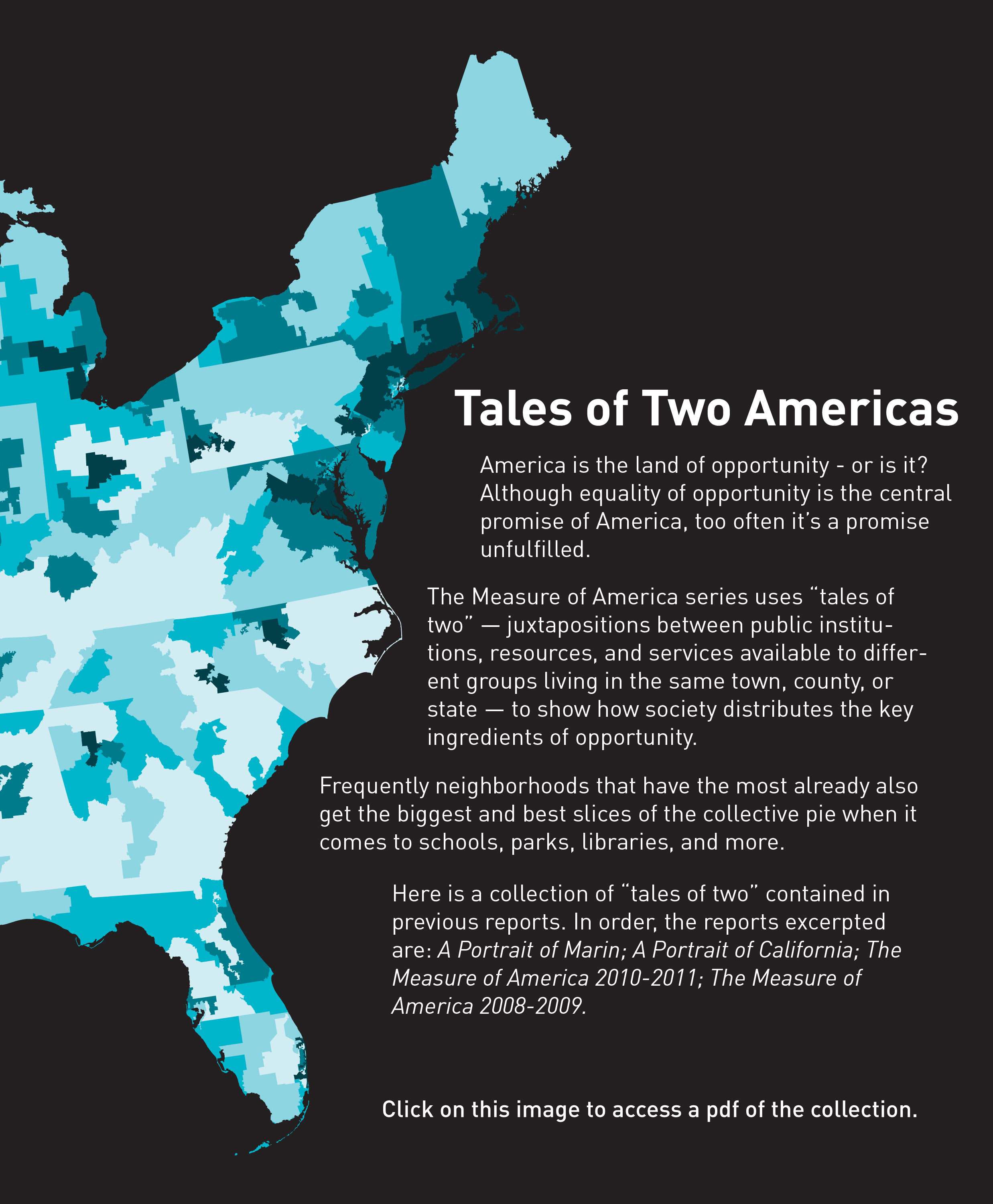 Tale of Two Americas
The Measure of America series uses “tales of two”—juxtapositions between public institutions, resources, and services available to different groups living in the same town, county, or state—to show how society distributes the key ingredients of opportunity.
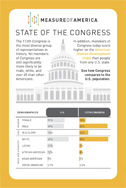
State of the Congress:
How representative are our representatives? The 113th Congress is the most diverse group of representatives in history. Yet its members are still significantly more likely to be male, white, and over 65 than other Americans. And in terms of basic well-being and access to opportunity, members of Congress are far ahead of the average in earnings and education but lag in life expectancy.

Youth Disconnection in New York City:
Following our recent “One in Seven” research on disconnected youth, we have taken a closer look at the 55 Census-defined neighborhoods of NYC. Which neighborhoods in each borough are doing best? Which struggle the most with youth disconnection—young people ages 16 to 24 who are neither in school nor working?
Women’s Well-Being: Ranking America’s Top 25 Metro Areas:
Women are not a monolithic group, and this report explores how different women are faring in the country’s most populous metropolitan areas. How do metro areas stack up when it comes to women’s choices, opportunities, and overall well-being? And how does your hometown rate?
A Century Apart 2010:
Our national conversation about race tends to take place in black and white, yet the greatest disparities in human well-being to be found in the U.S. are between Asian Americans in New Jersey and Native Americans in South Dakota. An entire century of human progress separates the worst-off from the best-off groups within the U.S.
 29 Reasons for Optimism 2010:
Residents of 29 countries live longer lives, on average, than Americans—while spending up to eight times less on their health. This report ranks the 50 states and Washington, D.C. against 80 countries in the world on life expectancy at birth, infant death rates, and annual per person spending on health care. The results powerfully demonstrate how better care and reining in costs are not incompatible.
__________________________________________________________________________
For media and all other inquiries, contact us at: contact@measureofamerica.org | (718) 517-3720.
